Kiturami Scholarship (귀뚜라미 장학금)
Kiturami Cultural Foundation
- One of 50 DGIST recipients, selected by the Student Scholarship Committee through a comprehensive evaluation of undergraduate research-project participants.
I am a B.S. candidate in Electrical Engineering and Computer Science at DGIST and an undergraduate researcher in the Intelligent Radio Sensing Lab. My research interests span integrated sensing and communication (ISAC), radar sensing, signal processing, and artificial intelligence.
Currently
My current focus is ISAC and drone sensing, combining RF propagation simulations with SDR measurements.
IEEE Internet of Things Journal (IoTJ), 2026 JCR Q1 · 2024
DOI: 10.1109/JIOT.2026.3746089 Public link pending
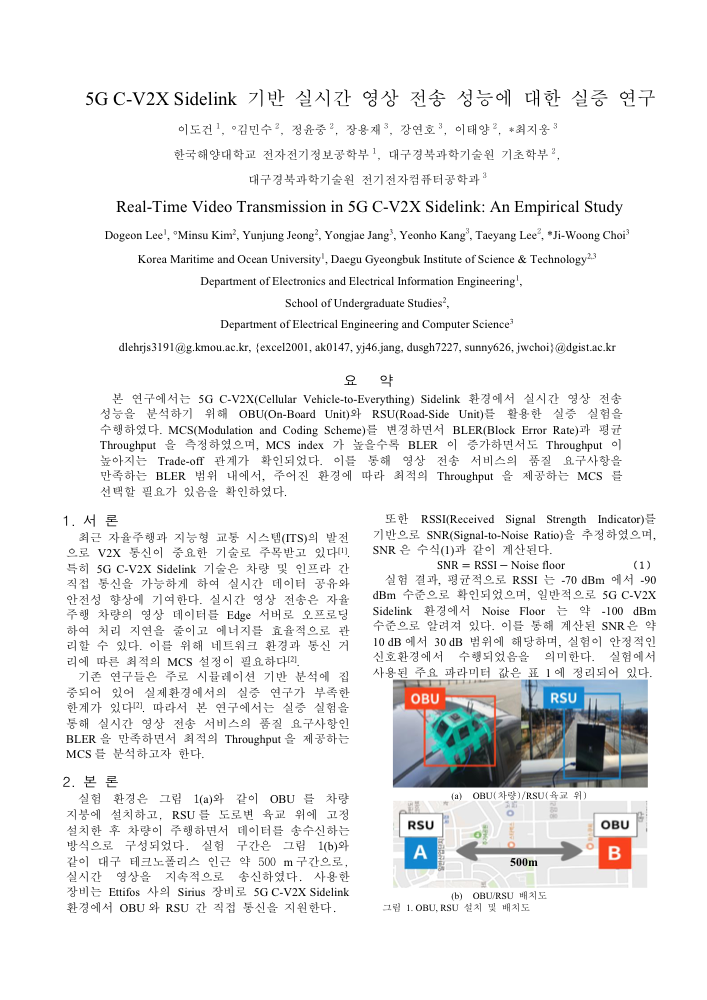
5G C-V2X Sidelink 기반 실시간 영상 전송 성능에 대한 실증 연구
JCCI, 2025
Kiturami Cultural Foundation
Winter Conference Idea Contest, Korean Institute of Communications and Information Sciences (KICS)
Intelligent Radio Sensing Lab (IRS Lab), DGIST · Advisor: Prof. Jae‑Ho Choi
Communication & Signal Processing Lab (CSP Lab), DGIST · Advisor: Prof. Ji‑Woong Choi
Introduction to Artificial Intelligence, DGIST
Linear Algebra, DGIST
Daegu Gyeongbuk Institute of Science & Technology (DGIST) · School of Undergraduate Studies
Republic of Korea Army · Completed
Exploring ISAC for drone sensing through RF propagation simulations in NVIDIA Sionna RT and SDR measurements. Simulation work and experimental data analysis are ongoing.
Recovered and analyzed respiration waveforms from ambient Wi-Fi measurements using a USRP-2921 and phase-based signal processing.
System Programming · Team Project
Developed a C-based game client with TCP/IP networking, minimax search with alpha-beta pruning for automated move selection, and a 64×64 RGB LED display. Our team placed second in the course tournament.
Explored system calls, concurrency, and virtual memory through C programming assignments in the xv6 RISC-V kernel, including user-level alarms, copy-on-write fork, and 2 MB superpages.